They Taught You How to Drive.
But Nobody Taught You This.
Your car won’t start.
A warning light flashes.
Or something under the hood makes a noise that sounds expensive.
Uh-oh.
You spent months learning how to drive.
Road signs. Four-way stops. Parallel parking.
You passed your test.
Got your license.
Bought a car.
And nobody thought to mention what happens when the damn thing breaks down.
Brilliant.
So now you’re sitting in a parking lot.
Your engine won’t start.
Your dashboard looks like a Christmas tree.
And your mechanical knowledge begins and ends with knowing where the gas goes.
Welcome to car ownership.
Here’s the good news.
You don’t need to become a mechanic.
You just need to know a few things mechanics wish every driver knew.
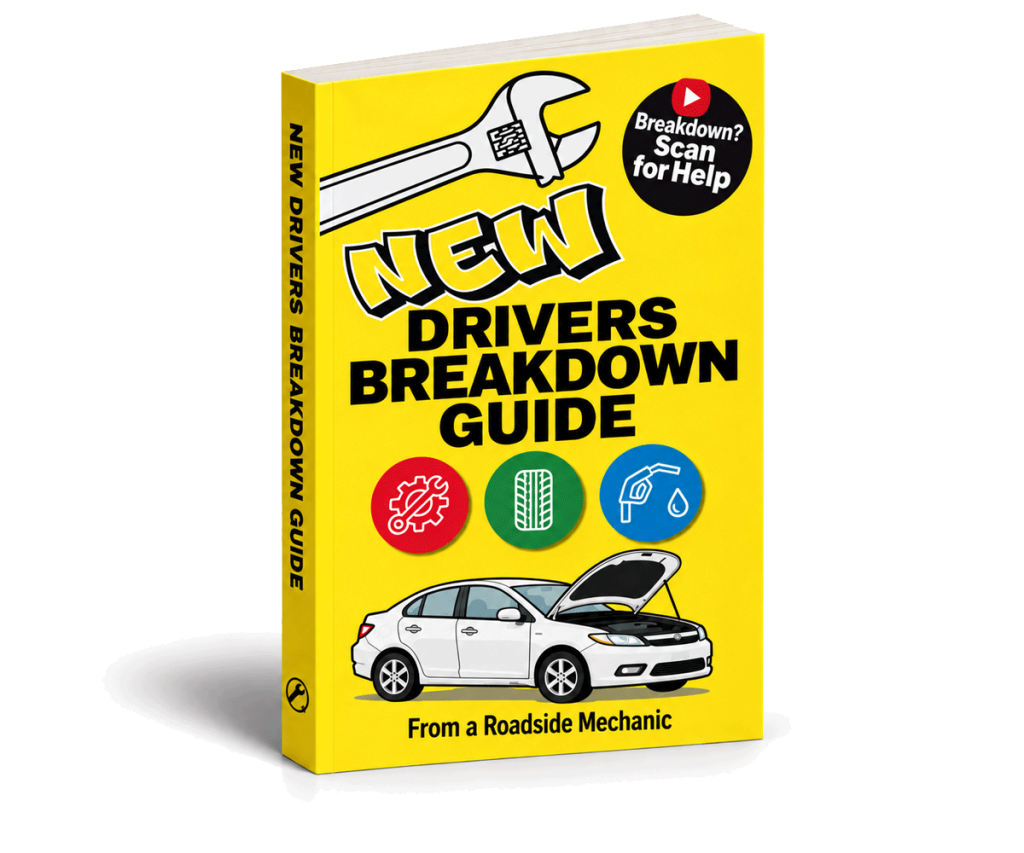
And after 25+ years fixing cars and rescuing stranded drivers, I’ve put those things into a book.
The New Driver’s Breakdown Guide.
Car know-how for people who don’t know cars.
I’ve Spent 25+ Years Fixing Cars.
Here’s What I’ve Learned About Drivers.
Most people don’t know much about cars.
And that’s perfectly fine.
You don’t need to understand fuel injection to drive to work.
I’ve spent years helping people stranded roadside.
Flat batteries.
Overheating engines.
Warning lights.
Breakdowns.
And a ton of “Oh that’s weird.”
And one question comes up more than any other.
“Can I still drive it?”
Sometimes yes.
Sometimes absolutely not.
And knowing which is which can make a big difference.
That’s why I wrote this book.
Not to teach you to rebuild an engine.
To teach you the stuff you wish you’d known five minutes before your car broke down.
E. John Cunningham
Red Seal Certified Auto Technician
RustyAutos.com
Your Car Is Trying to Tell You Something.
Trouble Is, It Doesn’t Speak English.
It clicks.
It rattles.
It squeals.
It flashes little warning symbols at you.
Very helpful.
Especially when you’re already late for work.
But here’s the thing.
Those noises, lights, and symptoms are clues.
And you don’t need to be a mechanic to start understanding them.
You just need someone to explain what they might mean.
In plain English.
Without turning a simple question into a two-hour lecture about engine management systems.
That’s where this book comes in.
Click. Click. Click.
Your Car Has Learned a New Language.
You turn the key.
Click. Click. Click.
Nothing.
You try again.
Because obviously the car might change its mind.
It doesn’t.
Here’s the interesting bit.
Those clicks are clues.
Rapid clicking? Often a weak battery or poor connection.
One solid click? Could be a starter problem.
Same car.
Same miserable morning.
Different possible problems.
And knowing the difference might save you a lot of unnecessary guessing.
That’s the kind of stuff inside this book.
Wait. The Book Has Videos?
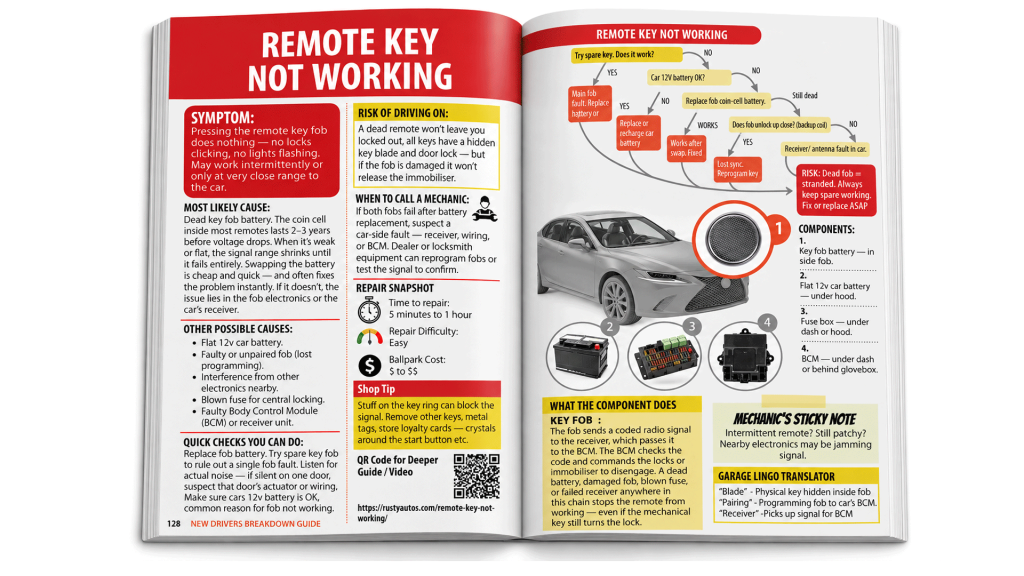
Yep.
Because sometimes a picture isn’t enough.
So I’ve included QR codes that take you straight to short video walkthroughs.
Read it. Scan it. Watch it make sense.
No complicated textbooks.
No hunting through random videos hoping you’ve found the right one.
Just another way to understand what’s going on.
SCAN IT. WATCH IT. GET IT.
Some Warning Lights Can Wait.

This Little Red Light Can Ruin Your Week.
Possibly Your Bank Account, Too.
See that?
It’s the oil pressure warning light.
And if it comes on while you’re driving, it could be telling you something very expensive is about to happen.
The engine might still sound fine.
The car might still drive.
That’s the trap.
Low oil pressure can destroy an engine surprisingly quickly.
So if that warning appears, pull over safely and switch off the engine as soon as it’s safe.
Don’t drive home to investigate.
Don’t wait until the weekend.
Because a warning light is a lot cheaper than an engine.
One little symbol.
One very important decision.
And one of the many things every driver should understand.
You Don’t Need to Fix Everything.
You Need to Know When NOT to Drive It.
Not every car problem is an emergency.
But some absolutely are.
And the trick is knowing the difference.
Sometimes it’s a simple check.
Sometimes it’s a trip to the garage.
And sometimes the smartest thing you can do is switch off the engine and call for help.
That’s not being mechanically minded.
That’s being prepared.
And that’s what this book is about.
Don’t Take My Word for It.
Have a Nosey Inside.
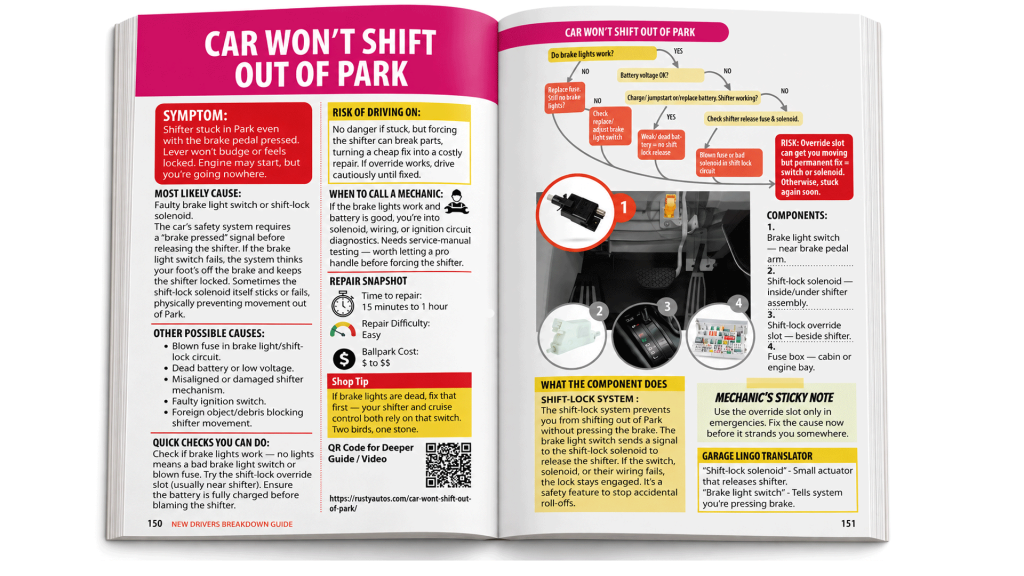
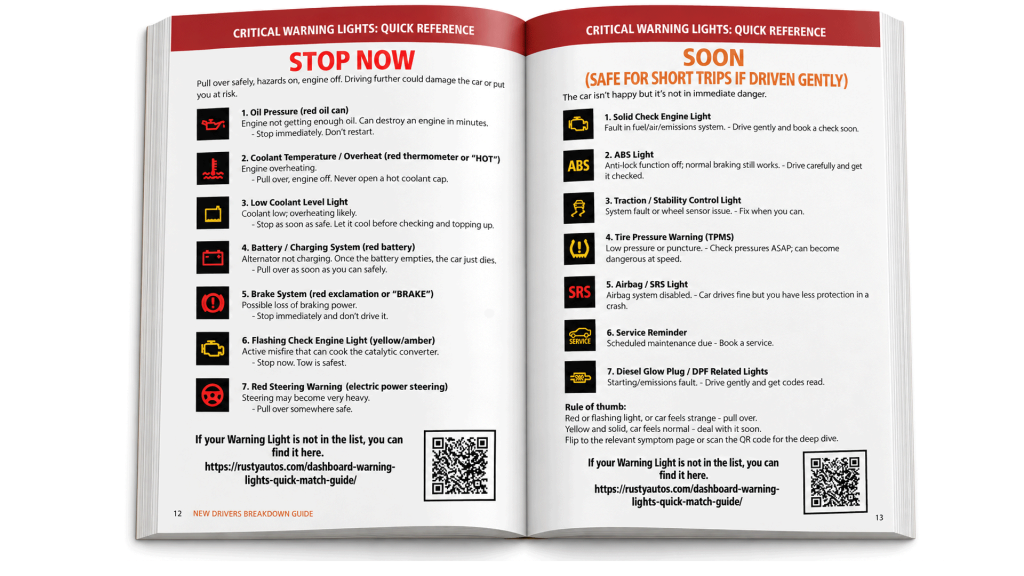
Here’s the actual book.
Not a mock-up full of promises.
Not 200 pages of mechanical jargon.
Just practical advice, illustrations, and explanations written for ordinary drivers.
Go on.
Have a flick through.
Take a Closer Look on Amazon →
Imagine Knowing What to Do Before You Panic.
Your car won’t start outside the supermarket.
Instead of immediately assuming the worst, you know which clues to look for.
A dashboard warning light appears.
Instead of ignoring it, you understand why some warnings demand immediate attention.
Your engine starts making an unfamiliar noise.
Instead of guessing, you know what details might help a mechanic identify the problem.
Will you suddenly know how to repair every car fault?
Of course not.
But you’ll be better prepared to ask the right questions and make informed decisions.
And that can make a stressful situation a lot easier to manage.
Here’s Who This Book Is Really For.
Who’s it for?
New driver?
Yep.
First car?
Definitely.
Know absolutely nothing about engines?
You’re my kind of reader.
Been driving for 20 years and still don’t know what half the dashboard lights mean?
Your secret’s safe with me.
Parent of a new driver?
Put one in their glovebox.
Here’s Something Worth Thinking About.
We Prepare for the Driving Test. But Not the Breakdown.
We spend hours learning road signs.
Practicing maneuvers.
Studying the rules of the road.
And rightly so.
But how much time do we spend learning what to do when the engine overheats?
Or the car won’t start?
Or a serious warning light comes on?
Not so much.
Yet those are exactly the moments when a little knowledge can make a big difference.
You will at some point need the information in this book.
Make life easy on your future self – be prepared.
A Great Gift for Someone Who’s Just Started Driving.
Another air freshener?
A novelty keyring?
A mug that says World’s Best Driver?
Lovely.
But here’s an idea.
Give them something that might actually help when their car breaks down.
The New Driver’s Breakdown Guide makes a practical gift for someone learning to drive, buying their first car, or heading off on their own.
Because independence is wonderful.
But being prepared?
Even better.
GRAB IT ON AMAZON →
A Few Questions Before You Go.
Do I need to know anything about mechanics?
No. The book is designed for drivers without a mechanical background. It explains common problems and warning signs in accessible language.
Will this teach me to repair my own car?
No. It’s a guide to understanding symptoms, making basic checks where appropriate, and deciding what to do next. It isn’t a substitute for a full workshop repair manual.
Is it just for brand-new drivers?
Not at all. It’s also useful for experienced drivers who want a better understanding of common car problems.
Will it help me avoid unnecessary garage visits?
Yes. It will help you recognize simple problems and understand when professional assistance is needed. But it can’t replace a proper diagnosis, and some faults require a qualified mechanic.
Can I look inside before buying?
Absolutely. Watch the flip-through video above to see the book’s layout and illustrations.
One Last Thing.
Your car probably won’t break down today.
Hopefully not tomorrow, either.
But one day?
You will turn the key and hear nothing.
Or see a warning light you’ve never noticed before.
Or hear a noise that makes you turn the radio down.
And when that happens, a little knowledge goes a long way.
That’s why I wrote this book.
Not to turn you into a mechanic.
To help you know what to do when your car lets you down.
Your Car Will Warn You Before It Breaks Down.
And that’s another reason to read the book.
Look.
You don’t need to know everything about cars.
You just need to know enough to avoid making a bad situation worse.
What’s wrong?
What can I do?
Can I keep driving?
Three questions.
One very handy little book.
The New Driver’s Breakdown Guide
KEEP IT IN THE GLOVEBOX.
GRAB IT ON AMAZON →
Available on Amazon. See the product page for current pricing, formats, and delivery options.
Safety note: This guide provides general educational information. Vehicle faults can vary, and symptoms alone may not identify the cause. Always prioritize roadside safety, follow your vehicle manufacturer’s guidance, and seek professional assistance when necessary.
- About the Author
- Latest Posts


John Cunningham is an Automotive Technician and writer on Rustyautos.com. He’s been a mechanic for over twenty-five years and has worked for GM, Volvo, Volkswagen, Land Rover, and Jaguar dealerships.
John uses his know-how and experience to write articles that help fellow gearheads with all aspects of vehicle ownership, including maintenance, repair, and troubleshooting.