
Lesson 1 of 12 — What Is an Engine?
Difficulty: ⭐☆☆☆☆ Beginner
Estimated Reading Time: 8–10 minutes
Your Journey Through Engine Fundamentals
✅ Lesson 1 – What Is an Engine? (Current Lesson)
⬜ Lesson 2 – The Four-Stroke Cycle
⬜ Lesson 3 – Pistons
⬜ Lesson 4 – Connecting Rods
⬜ Lesson 5 – Crankshaft
⬜ Lesson 6 – Flywheel
⬜ Lesson 7 – Camshaft
⬜ Lesson 8 – Valves
⬜ Lesson 9 – Timing Systems
⬜ Lesson 10 – Lubrication
⬜ Lesson 11 – Cooling
⬜ Lesson 12 – Putting It All Together
Before We Begin
Every time you drive a gas (also known as petrol in Europe) or diesel car, you’re travelling because thousands of tiny explosions are happening every minute beneath the hood.
That might sound violent, but one of the greatest achievements in engineering is turning those explosions into something so smooth that you barely notice them.
By the end of this lesson, you’ll understand what an engine really is, why every traditional car needs one, and how it fits into the rest of the vehicle.
No mechanical knowledge required.
Just curiosity.
Timing Cover
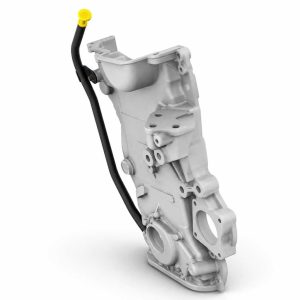
The timing cover sits at the front of the engine and protects the timing belt or chain. This system keeps the camshaft and crankshaft synchronized so the valves open and close at the correct time as the pistons move.
The cover also helps keep dirt out and, on chain-driven engines, seals lubricating oil inside.
Main job: Protects the parts that keep the engine perfectly timed.
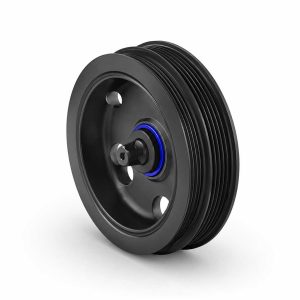
Crankshaft Pulley
Valve Cover
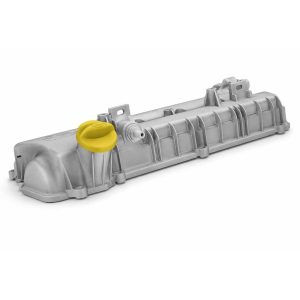
The valve cover sits on top of the cylinder head and protects the camshaft and valve train from dirt and moisture. It also seals engine oil inside the engine, preventing leaks while allowing oil to lubricate the moving parts beneath.
Many valve covers also provide mounting points for components such as the oil filler cap, ignition coils, or the PCV system.
Main job: Protects the valve train and keeps engine oil sealed inside.
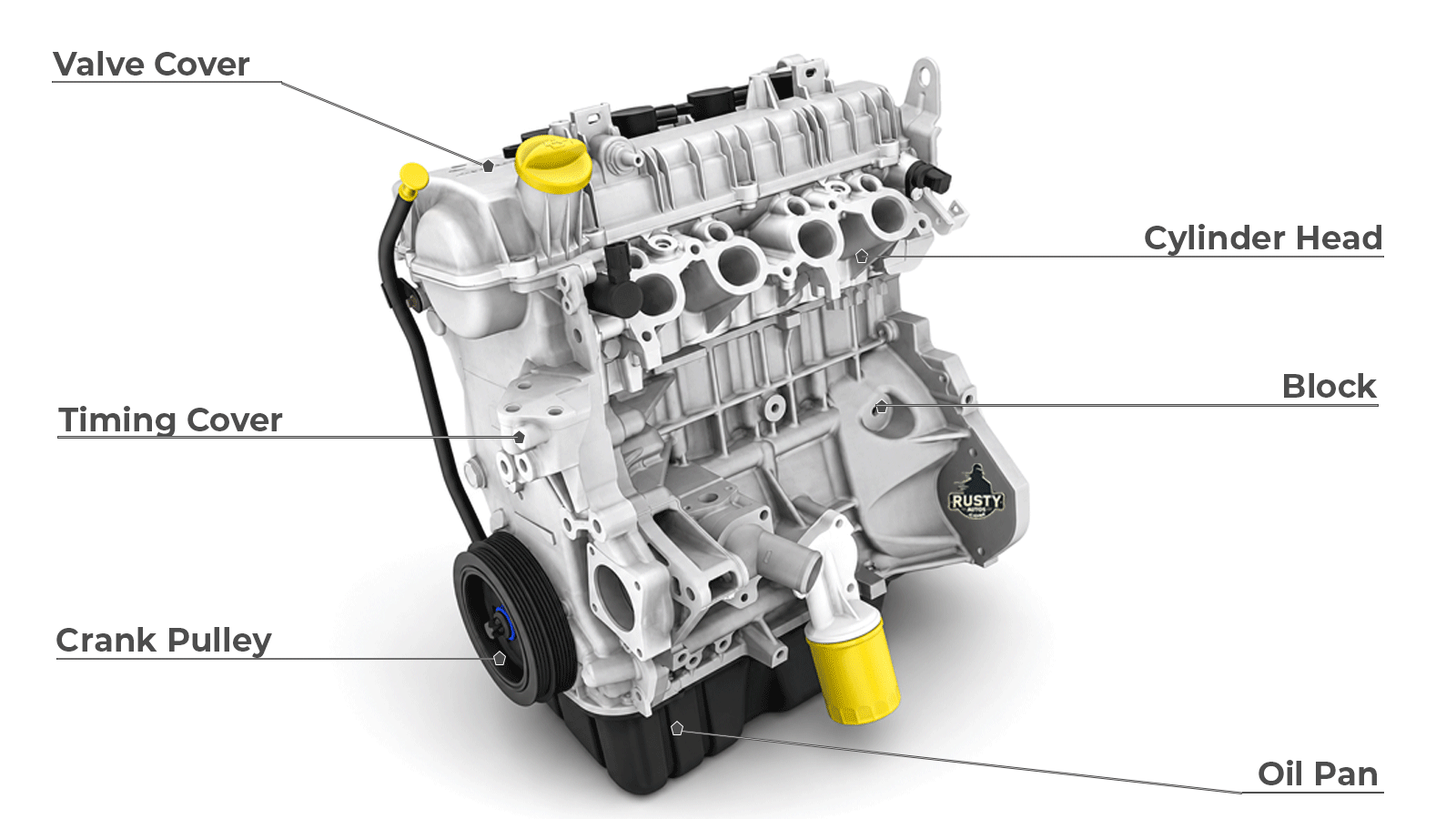
Cylinder Head
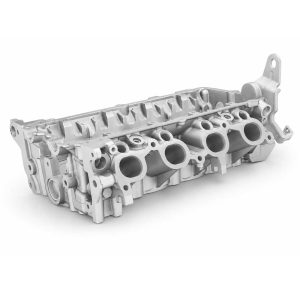
The cylinder head sits on top of the engine block and seals the combustion chambers. It houses important components such as the valves, camshaft, spark plugs (or glow plugs on diesel engines), and fuel injectors on many modern engines.
Air enters, exhaust gases leave, and combustion takes place beneath the cylinder head, making it one of the engine’s most important components.
Main job: Seals the cylinders and controls the flow of air, fuel, and exhaust gases.
Block
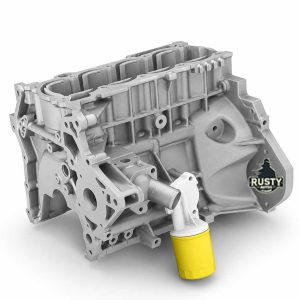
The engine block is the main body of the engine and provides the foundation for almost every major component. It contains the cylinders where the pistons move up and down, along with oil galleries and coolant passages that help lubricate and cool the engine.
The cylinder head bolts to the top of the block, while the crankshaft is supported inside it.
Main job: Supports the engine’s moving parts and houses the cylinders where power is produced.
Oil Pan
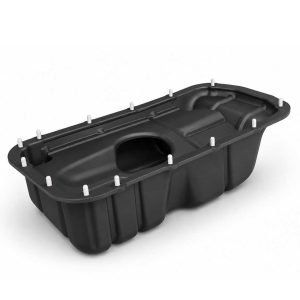
The oil pan, also called the sump, is bolted to the bottom of the engine block and stores the engine’s supply of oil. As the engine runs, oil drains back into the pan before being pumped around the engine again to lubricate and cool moving parts.
The oil pan also provides a mounting point for the oil drain plug, making routine oil changes possible.
Main job: Stores engine oil and supplies it to the lubrication system.
So…What Is an Engine?
An engine is a machine that converts the energy stored in fuel into mechanical movement.
That’s its only job.
It doesn’t steer the car.
It doesn’t stop the car.
It doesn’t keep you warm or cold.
Its job is simply to produce rotational power that eventually turns the wheels.
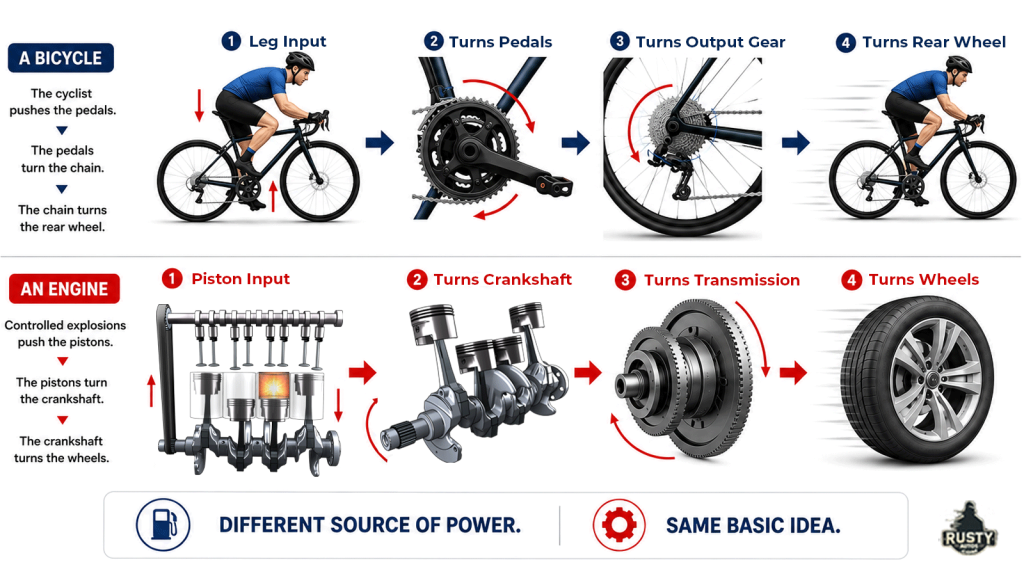
Think of it like the cyclist on a bicycle.
The cyclist pushes the pedals.
The pedals turn the chain.
The chain turns the rear wheel.
An engine does exactly the same thing.
Instead of leg muscles pushing pedals, controlled explosions push pistons.
Those pistons turn a crankshaft.
The crankshaft eventually turns the wheels.
Different source of power.
Same basic idea.
The Engine’s Four Jobs
Although engines look incredibly complicated, every gas (petrol) and diesel engine performs four simple jobs.
1. Breathe
The engine draws fresh air inside.
Just like you need oxygen to survive, an engine needs oxygen to burn fuel.
2. Eat
Fuel is added to the air.
Gas (Petrol) or diesel stores enormous amounts of energy.
The engine’s job is to release that energy in a controlled way.
3. Create Power
The fuel and air mixture burns inside the cylinders.
The expanding gases push the pistons downward.
This is where useful work is created.
4. Turn the Wheels
The pistons move up and down.
The crankshaft converts that movement into rotation.
That rotation eventually reaches the wheels.
Without this final step, the engine would simply shake itself apart without moving the car.
Illustration: Simple flow diagram showing Fuel + Air → Combustion → Pistons → Crankshaft → Transmission → Wheels.
Where Does the Power Go?
The engine isn’t connected directly to the wheels.
Instead, the power takes a journey.
Engine
↓
Flywheel
↓
Transmission
↓
Differential
↓
Driveshafts
↓
Wheels
Every one of those components has an important job.
And during this course, you’ll learn exactly how each one works.
Why Doesn’t the Engine Explode?
This is one of the most common questions people ask.
After all, engines contain hundreds of explosions every minute.
The answer is surprisingly simple.
The explosions are carefully controlled.
They happen inside incredibly strong metal cylinders.
Each explosion pushes a piston only a short distance.
Everything is precisely timed.
Instead of chaos, the engine creates smooth, predictable movement.
It’s less like a bomb and more like hundreds of tiny, perfectly organised pushes.
Meet the Main Players
Although we’ll study each of these in detail later, it’s worth meeting them now.
Pistons
These move up and down inside the cylinders.
Think of them as the engine’s muscles.
Connecting Rods
They connect each piston to the crankshaft.
They’re the engine’s arms.
Crankshaft
This clever component converts the pistons’ up-and-down motion into smooth rotation.
Without it, your wheels could never turn.
Camshaft
The camshaft opens and closes the valves at exactly the right moment.
Good timing is everything.
Valves
These allow fresh air in and let burnt gases out.
Think of them as automatic doors.
Spark Plugs (Gas/Petrol Engines)
Spark plugs ignite the fuel-air mixture.
They provide the tiny spark that starts each controlled explosion.
Fuel Injectors
These deliver fuel in tiny, precisely measured amounts.
Modern injectors are incredibly accurate.
Illustration: Exploded Blender view with each component colour-coded and labelled.
Why Is an Engine Such Clever Engineering?
An engine looks simple from the outside.
A metal block.
Some pipes.
A few belts.
But inside, everything happens with astonishing precision.
At just 3,000 RPM:
- Every piston changes direction 100 times every second.
- The valves open and close thousands of times every minute.
- Fuel is injected with incredible accuracy.
- Every explosion happens exactly when it’s needed.
If even one part loses its timing, the engine quickly loses efficiency—or may stop running altogether.
Mechanic’s Corner
One thing that surprised me early in my career was just how reliable modern engines really are.
Most of the serious engine failures I’ve seen weren’t because the engine itself was poorly designed.
Instead, another system failed first.
A cooling problem caused overheating.
A lubrication problem starved the bearings of oil.
A timing belt snapped.
The engine simply suffered the consequences.
That’s one reason understanding the whole engine—not just one part—is so valuable.
Did You Know?
- A four-cylinder engine running at 3,000 RPM creates around 100 controlled combustion events every second.
- Temperatures inside a combustion chamber can briefly exceed 2,000°C (3,600°F).
- Modern engines often contain more than 2,000 individual components.
- A family car engine may rotate its crankshaft well over one billion times during its lifetime.
- Many modern engines can travel more than 200,000 miles with regular maintenance.
Common Questions
Is the engine the same as the motor?
Strictly speaking, gas (petrol) and diesel vehicles use engines, while electric vehicles use motors. In everyday conversation, people often use the words interchangeably.
Why are engines made from aluminium and iron?
These materials provide an excellent balance of strength, weight, durability, and heat resistance.
Why do engines get hot?
Burning fuel releases enormous amounts of heat. The cooling system prevents the engine from overheating.
Can an engine run without oil?
Only for a very short time. Oil protects moving parts by reducing friction and carrying away heat.
Why do engines vibrate?
Because many heavy components are constantly changing direction. Engineers carefully balance the engine to reduce vibration.
Lesson Summary
Today, you’ve learned that an engine is much more than a collection of metal parts.
It’s a carefully engineered machine designed to convert the chemical energy stored in fuel into smooth, reliable motion.
You now understand:
- What an engine is.
- Why every gas (petrol) and diesel vehicle needs one.
- The engine’s four basic jobs.
- The major components you’ll study during this course.
- Why precision and timing are the secret to reliable engine operation.
This is only the beginning.
Every lesson from here builds on the one before it.
Congratulations!
You’ve completed Lesson 1 – What Is an Engine?
Next up:
▶ Lesson 2 – The Four-Stroke Cycle
This is where you’ll discover how thousands of tiny explosions are transformed into smooth, continuous power—and why almost every petrol engine in the world works on the same brilliant principle.
- About the Author
- Latest Posts


John Cunningham is an Automotive Technician and writer on Rustyautos.com. He’s been a mechanic for over twenty-five years and has worked for GM, Volvo, Volkswagen, Land Rover, and Jaguar dealerships.
John uses his know-how and experience to write articles that help fellow gearheads with all aspects of vehicle ownership, including maintenance, repair, and troubleshooting.