The tablet simply read:
VW Golf – Overheating in Traffic.
Nothing unusual there.
I headed toward the job expecting the usual suspects.
Thermostat.
Cooling fan.
Water pump.
Maybe even a head gasket if the driver had ignored the warning lights long enough.
When I arrived, the member was standing beside a black VW Golf.
Sharp-looking thing.
Big alloys.
Low profile tyres.
The sort of car I would have spent every spare penny on at his age.
He looked disappointed.
Not angry.
Not stressed.
Just disappointed.
That’s usually a good sign.
The really expensive breakdowns tend to produce a completely different facial expression.
I asked what happened.
He told me he was on the way to a game when traffic suddenly backed up.
Everything had been fine.
Then he noticed the temperature gauge climbing.
Then came the steam.
To his credit, he did exactly the right thing.
He pulled over.
Immediately.
That decision probably saved him thousands.
I checked the basics first.
Oil level?
Perfect.
Coolant level?
Low.
Very low.
The engine had cooled by the time I arrived, so I told him we weren’t going to assume the worst just yet.
You could almost see the relief on his face.
A lot of drivers hear the word “overheating” and immediately think:
Engine gone.
Head gasket.
Game over.
Not always.
I asked him another question.
“Did it restart after it overheated?”
“No.”
That worried him.
I told him not to panic.
A seriously overheated engine often won’t restart straight away. Modern engine management systems can shut things down to protect components, and excessive heat can cause all sorts of temporary issues.
The important thing was finding out why it overheated in the first place.
So we topped up the cooling system with water and started investigating.
Now the fun part begins.
When you’re chasing a cooling fault, you’re looking for clues.
Leaks.
Collapsed hoses.
Cooling fan problems.
Water pump issues.
Blocked radiators.
Stuck thermostats.
Something always leaves a trail.
This one didn’t take long.
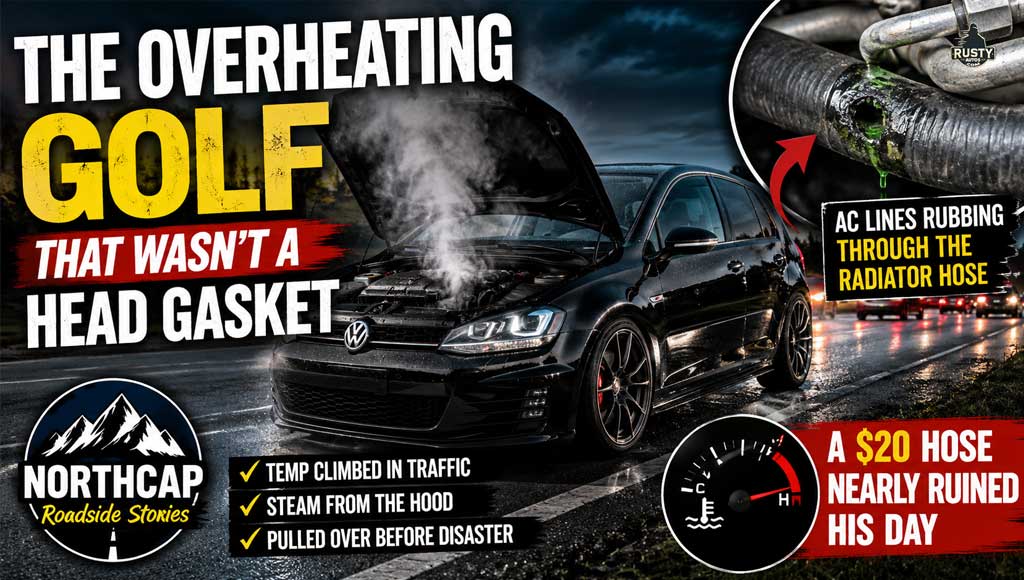
As the cooling system filled, I spotted coolant dripping from underneath.
A closer look revealed a tiny hole in the lower radiator hose.
The cause was even more interesting.
The air-conditioning hard lines were sitting directly against the rubber coolant hose.
Vibration had slowly rubbed through the hose wall.
Think of it like taking sandpaper to a garden hose for several thousand miles.
Eventually the hose loses.
I asked him if he’d had air-conditioning work done recently.
“Last summer.”
Bingo.
The AC lines had likely been routed incorrectly during the repair.
Nothing dramatic.
Nothing exotic.
Just one component sitting where it shouldn’t.
And over time it quietly created a breakdown.
The good news?
The engine was fine.
No signs of internal damage.
No evidence of a blown head gasket.
No horror story waiting around the corner.
He’d need a new radiator hose and the AC lines properly secured away from it.
Simple repair.
But it wasn’t a roadside fix.
This one was heading home on a truck.
As we waited for recovery, I asked him if his team won the game.
He looked at me and laughed.
“No.”
Honestly?
That’s still a win.
I’ve seen plenty of overheating jobs end far worse.
Sometimes the smartest thing a driver does all day is stop driving.
This young man did exactly that.
And it probably saved his Golf.
Would You Know What To Do?
If your engine warning light came on tonight, would you know to keep driving, pull over, or call for recovery?
Most drivers wouldn’t.
That’s exactly why I wrote this guide.

- About the Author
- Latest Posts


Meet Northcap, a seasoned mechanic and roadside assistance expert with over 20 years of hands-on experience. At Rustyautos.com, Northcap shares exclusive insights into what really breaks down in cars, offering practical tips and real-world advice to keep drivers informed and their cars on the road.