Some roadside calls stick with you because of the fault.
Others because of the people.
This one had both.
The dispatch simply read:
“Vehicle won’t start. Flat battery suspected.”
Nothing unusual there.
Then I noticed the location.
The circus.
Not a permanent one either—a traveling big-top circus that had just finished touring and was back at its home base for a couple of weeks before heading out on the road again.
I had no idea what to expect.
A Circus Without the Big Top
Instead of clowns and elephants, I pulled into what looked more like a country estate.
A large house sat in the middle of the property, surrounded by wide gravel parking areas packed with RVs, trailers, and semi-trucks that served as accommodation for the performers and crew.
Cream-painted metal railings enclosed rolling paddocks where livestock grazed peacefully.
It felt more like a ranch than a circus.
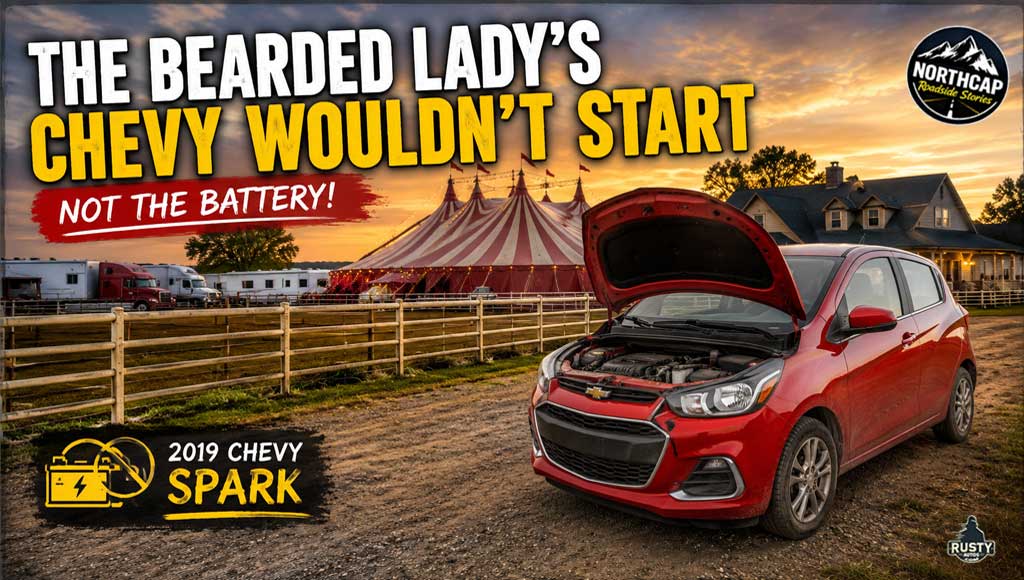
I found the member beside a little red 2019 Chevrolet Spark.
He explained the car wouldn’t crank and was convinced the battery had gone flat.
While we chatted, I asked the obvious question.
“So… what do you do at the circus?”
Without missing a beat he replied:
“I’m the Bearded Lady.”
I paused.
He looked completely serious.
Maybe he was joking.
Maybe he wasn’t.
These days I’ve learned not to assume either way.
So I simply nodded and got on with the job.
Rule Number One: Never Trust the Diagnosis
The first thing I checked was the battery.
Perfectly healthy.
Good voltage.
No problems at all.
That’s why roadside diagnostics always start with testing—not guessing.
If I’d simply fitted a battery because the customer believed it was flat, we’d both have been disappointed.
Suspect Number Two: The Starter Motor
The symptoms pointed toward the starter motor.
Turning the key produced…
Nothing.
No crank.
No attempt to turn the engine.
One quick roadside trick is to tap the starter motor gently while someone turns the key.
Sometimes worn brushes make temporary contact and the starter suddenly springs to life.
It’s one of those old mechanic’s tricks that can instantly confirm a failing starter.
I gave it a try.
Nothing.
Worth trying…
But it certainly didn’t clear the starter of suspicion.
Time for the Test Light
Now it was time for my favorite diagnostic tool.
A simple power probe or test light can answer an important question in seconds.
I checked the small trigger wire going into the starter solenoid.
This wire should receive battery voltage only when the ignition key is turned fully to the START position (Position 3), not merely when the ignition is switched on.
Sure enough…
The power arrived exactly as it should.
That told me a lot.
- The ignition switch was working.
- The wiring to the starter was intact.
- The safety interlocks were allowing the engine to crank.
- The starter motor simply wasn’t responding.
At that point the diagnosis was becoming fairly clear.
One Last Trick
Before condemning the starter completely, I tried one final test.
Because this was a manual transmission, we could rock the car backward and forward while it was left in gear.
This does two useful things.
First, if the starter’s drive gear has jammed against the flywheel, moving the engine slightly can free it.
Second, it confirms the engine itself isn’t seized.
If the car rocks normally, you’re far less likely to be dealing with something catastrophic like a seized engine, a dropped valve, or a hydrolocked cylinder.
I wasn’t expecting any of those.
After all, the member said the Spark had driven into the circus grounds without any problems.
The engine rotated normally.
Everything kept pointing back to the starter motor.
The Plan
I explained the situation.
“We can probably bump-start it,” I said.
“But once you switch it off, there’s a good chance it won’t restart until that starter motor is replaced.”
He didn’t hesitate.
“That’s fine,” he replied.
“I’ll drive straight to my mechanic.”
A sensible decision.
One Unexpected Delay
Normally, bump-starting a small manual car takes only a few minutes.
Not here.
Every few minutes another semi-truck or RV rolled through the yard as circus staff returned from the tour.
Finding enough clear space safely took nearly twenty minutes.
Eventually we had a gap.
A short push.
Second gear.
Clutch out.
The little red Spark coughed…
Then burst into life.
Exactly as expected.
What Actually Failed?
Everything pointed to a failed starter motor.
The battery tested healthy.
The starter received its trigger voltage.
The engine wasn’t seized.
The vehicle bump-started immediately.
Those four facts together make a very strong roadside diagnosis.
Sometimes the simplest fault-finding process tells you everything you need to know.
And sometimes…
You leave a circus having spent the afternoon diagnosing a Chevrolet for someone who may—or may not—have been the Bearded Lady.
Either way, it was certainly one of the more memorable calls.
YOUR CAR JUST SAID “UH-OH.”
Warning light? Won’t start? Weird noise?
Something smells expensive?
DON’T PANIC. KNOW WHAT TO DO NEXT.
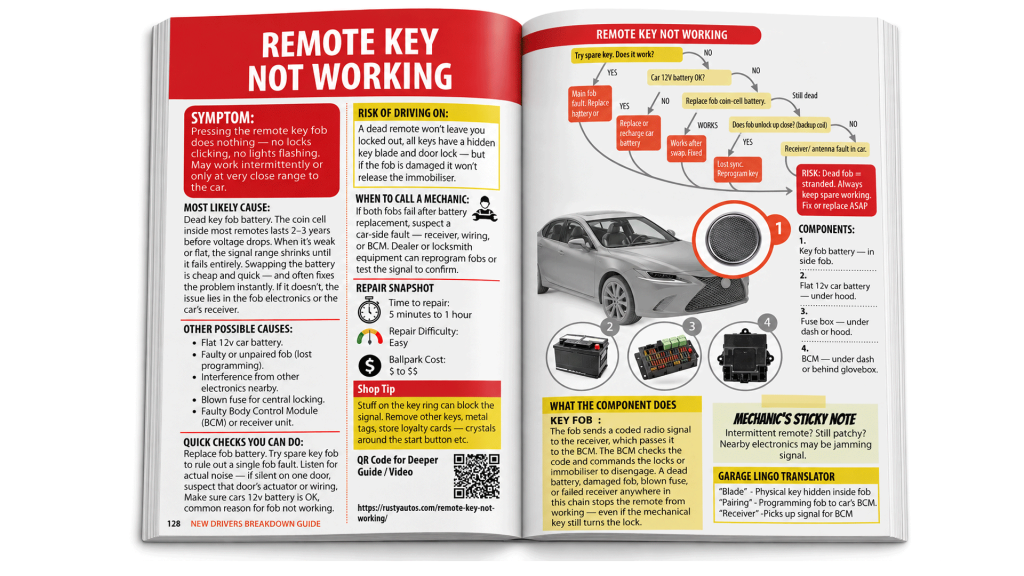
The New Driver’s Breakdown Guide gives you the car know-how nobody taught you.
- About the Author
- Latest Posts


Meet Northcap, a seasoned mechanic and roadside assistance expert with over 20 years of hands-on experience. At Rustyautos.com, Northcap shares exclusive insights into what really breaks down in cars, offering practical tips and real-world advice to keep drivers informed and their cars on the road.