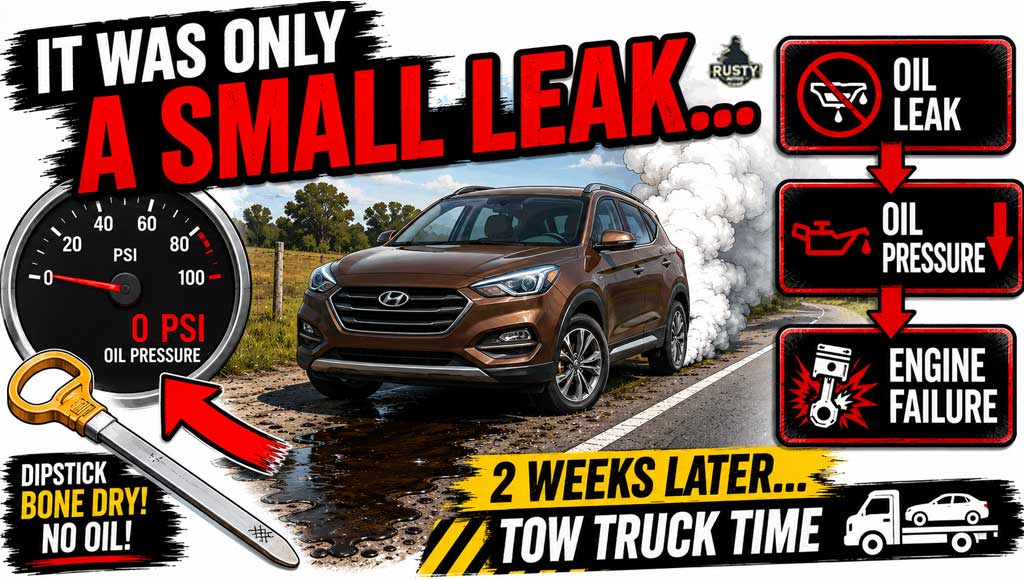
This breakdown didn’t start on the side of the road.
It started two weeks earlier in a workshop.
That’s when somebody told this driver he had a small oil leak.
When I arrived at the scene, the member was standing beside his Hyundai, looking absolutely defeated.
That’s never a good sign.
Usually, by the time somebody has that look on their face, they already know this isn’t going to be a quick roadside fix.
I asked him what happened.
“I was driving along,” he said, “and I could see white smoke in the mirror.”
White smoke.
Then he told me the engine started losing power.
Not all at once.
First a little.
Then a lot.
Then everything.
The car coasted to the side of the road and died.
When he got out, he noticed oil underneath it.
Lots of oil.
I started joining the dots.
White smoke.
Oil loss.
Sudden power loss.
None of those are good signs on their own.
Together?
That’s a very expensive combination.
The First Check
Whenever I arrive at a breakdown, I like checking the vitals first.
Oil.
Coolant.
Battery.
The basics.
The oil dipstick told the story before I even touched a scanner.
Nothing.
Bone dry.
Not low.
Not slightly below minimum.
Zero.
The underside of the vehicle was soaked in oil.
The side of the transmission was coated.
Everything underneath had that unmistakable oily shine.
I asked if the car had any previous oil leaks.
“Funny you should say that,” he replied.
“It was serviced about two weeks ago and they mentioned a small oil leak.”
Well.
It wasn’t small anymore.
What I Think Happened
Roadside diagnostics isn’t about proving every theory beyond doubt.
It’s about gathering enough evidence to understand what’s most likely happening.
My suspicion was fairly straightforward.
The engine had lost a huge amount of oil.
Enough to starve critical components.
I believe the turbocharger failed first.
That would explain the white smoke.
When turbo seals let go, they can dump oil directly into the intake and exhaust system.
The result can look like somebody has set off a smoke grenade behind the car.
But I didn’t think the turbo was the whole story.
I suspected the oil starvation may have also affected the timing chain tensioner.
Timing chain tensioners rely on engine oil pressure to maintain chain tension.
Lose enough oil pressure and bad things can happen.
The chain develops slack.
Timing jumps.
And if timing jumps far enough, valves and pistons start occupying the same space.
That’s a very expensive meeting.
A Small Ray of Hope
Before making any assumptions, I wanted to know if the engine had locked up.
We topped up the oil.
With the ignition disabled, I manually rotated the engine through two complete revolutions.
Everything turned freely.
No obvious mechanical interference.
No horrible clunks.
No sudden stops.
That was encouraging.
Then I scanned it, no fault codes. Next, we cranked it.
The engine spun over.
But something didn’t sound right.
You get used to the sound of healthy timing.
You also get used to the sound when it isn’t.
This one had uneven spots while cranking.
Nothing I could prove at the roadside.
But enough to make me very suspicious.
Then Came the Plot Twist
While looking around the engine bay, I noticed something interesting.
Several components looked surprisingly new.
The turbo looked fresh.
The cylinder head had that clean metallic shine you only see on recently rebuilt engines.
A few other parts looked recently fitted too.
I asked about it.
The member sighed.
“The engine was rebuilt less than a year ago.”
That changed everything.
Because now I wasn’t just looking at a breakdown.
I was looking at a recently rebuilt engine that appeared to have lost most of its oil.
And from what I could see underneath, the leak looked substantial enough to be coming from a major oil gallery.
Potentially around the cylinder head area.
Exactly where I’d expect to find a leak capable of emptying an engine in short order.
The Long Ride Home
I explained everything as clearly as I could.
The turbo likely failed.
The timing may have jumped.
The top end may have suffered oil starvation.
The actual source of the leak still needed to be confirmed once the workshop stripped components away.
But I felt confident we were close to the truth.
Unfortunately, this wasn’t going to be a roadside repair.
This was a flatbed job.
As we waited for recovery, I could see what was going through his mind.
A rebuilt engine.
A recent service.
A massive oil leak.
And now a tow truck.
Sometimes that’s the hardest part of the job.
Not fixing cars.
Delivering bad news.
The loader arrived.
The car went one way.
The member headed for the bus stop.
And I headed for the next call.
Most engine failures don’t happen suddenly.
They send warnings first.
Oil spots on the driveway.
A slight burning smell.
The occasional drop on the garage floor.
The problem is that small oil leaks rarely stay small.
And engine oil is one fluid your engine absolutely cannot live without.
If your vehicle has an active oil leak, don’t monitor it.
Fix it.
Because sometimes the most expensive breakdowns start with the words:
“It’s only a small leak.”
Would You Know What To Do?
If your engine warning light came on tonight, would you know to keep driving, pull over, or call for recovery?
Most drivers wouldn’t.
That’s exactly why I wrote this guide.

- About the Author
- Latest Posts


Meet Northcap, a seasoned mechanic and roadside assistance expert with over 20 years of hands-on experience. At Rustyautos.com, Northcap shares exclusive insights into what really breaks down in cars, offering practical tips and real-world advice to keep drivers informed and their cars on the road.