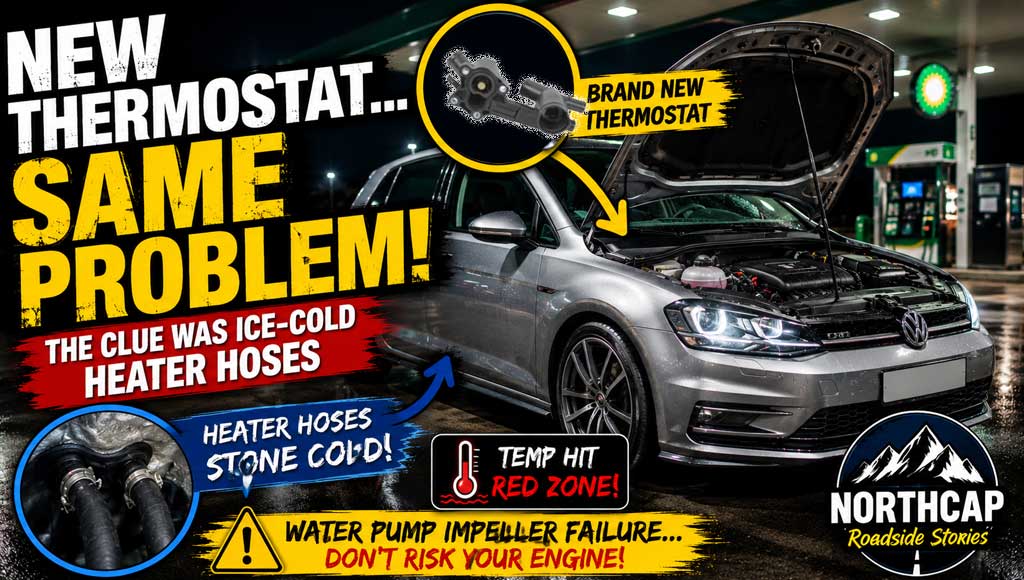
Another late-night gas station call.
The tablet simply said:
“VW overheating.”
No other details.
When I arrived, I found a disappointed Golf owner standing beside his car.
He was nearly home.
That’s always the way.
The breakdowns never happen at the start of the journey. They wait until you’re ten minutes from your driveway.
The driver explained that the temperature gauge had been acting strangely for a few miles.
Then suddenly the warning appeared.
To his credit, he did exactly the right thing.
He pulled over immediately and shut off the engine.
That one decision may have saved him thousands.
By the time I arrived, the engine had cooled.
He’d already topped up the coolant, which wasn’t unusual. Most overheating engines will push coolant out as temperatures climb.
I started with the basics.
Coolant level?
Good.
Radiator?
No leaks.
Hoses?
All intact.
Expansion bottle?
Fine.
Oil level?
Perfect.
People often forget that low engine oil can contribute to overheating, so it’s always worth checking.
Everything looked normal.
Almost.
Then I spotted something interesting.
The thermostat housing looked brand new.
You can usually tell.
Fresh plastic.
Clean bolts.
No dirt or road grime.
I asked the owner about it.
“Yeah,” he said. “VW—replaced it about a week ago.”
“Why was it replaced?”
“The engine was intermittently overheating.”
That was my first real clue.
The thermostat had been replaced because someone suspected it wasn’t opening properly.
Fair enough.
But if the overheating problem persists after a thermostat replacement, either the diagnosis was wrong, or another fault is hiding in the system.
So I asked him to start the engine.
It fired up immediately.
No warning lights.
No unusual noises.
No misfires.
Nothing obvious.
We let it idle and warm up.
As it heated, I kept checking temperatures by hand.
The upper and lower radiator hoses became warm.
That’s generally a good sign.
Coolant was reaching the radiator.
But something else caught my attention.
The heater hoses running through the firewall were stone cold.
Not cool.
Cold.
That shouldn’t happen.
By this stage, I was becoming suspicious of the water pump.
Many modern pumps use plastic impellers.
Over time, the plastic can crack, wear, or separate from the metal shaft.
The pulley turns.
The shaft turns.
But the impeller inside the pump housing barely moves the coolant.
From the outside, everything appears normal.
Inside, circulation has almost stopped.
Then right on cue, the owner shouted from the driver’s seat.
“It’s shooting past ninety degrees!”
That was enough for me.
“Shut her down.”
The engine stopped.
The diagnosis was becoming clearer.
This wasn’t a thermostat problem.
This was a water pump failure.
The owner wasn’t thrilled.
They never are.
Nobody likes hearing their car needs more work after it has already been in a workshop.
But I gave him the same advice I’d given dozens of times before.
A water pump is cheap.
An overheated engine isn’t.
Keep driving an overheating engine, and you’re gambling with:
- Head gasket failure
- Warped cylinder head
- Cracked cylinder head
- Engine damage that can run into thousands
A tow truck suddenly starts looking very affordable.
Would You Know What To Do?
If your engine warning light came on tonight, would you know to keep driving, pull over, or call for recovery?
Most drivers wouldn’t.
That’s exactly why I wrote this guide.

- About the Author
- Latest Posts


Meet Northcap, a seasoned mechanic and roadside assistance expert with over 20 years of hands-on experience. At Rustyautos.com, Northcap shares exclusive insights into what really breaks down in cars, offering practical tips and real-world advice to keep drivers informed and their cars on the road.