
If your check engine light is on and a scan reveals P0171 – System Too Lean (Bank 1), your engine is running with too much air and not enough fuel. While this might not cause immediate breakdowns, ignoring it can lead to poor performance, higher fuel consumption, and even long-term engine damage.
A lean condition means the air-fuel ratio is off—there’s too much air or not enough fuel reaching the combustion chambers. Your car’s engine control module (ECM) detects this imbalance and triggers the P0171 code to warn you. But what’s causing it?
It could be something simple, like a vacuum leak or a dirty mass airflow (MAF) sensor, or something more serious, like low fuel pressure or clogged injectors.
The good news? Most causes of P0171 are easy to diagnose and fix—and many don’t require a trip to the mechanic. In this guide, we’ll break down what this code means, the most common causes, how to diagnose it, and the best ways to fix it. Let’s get started.
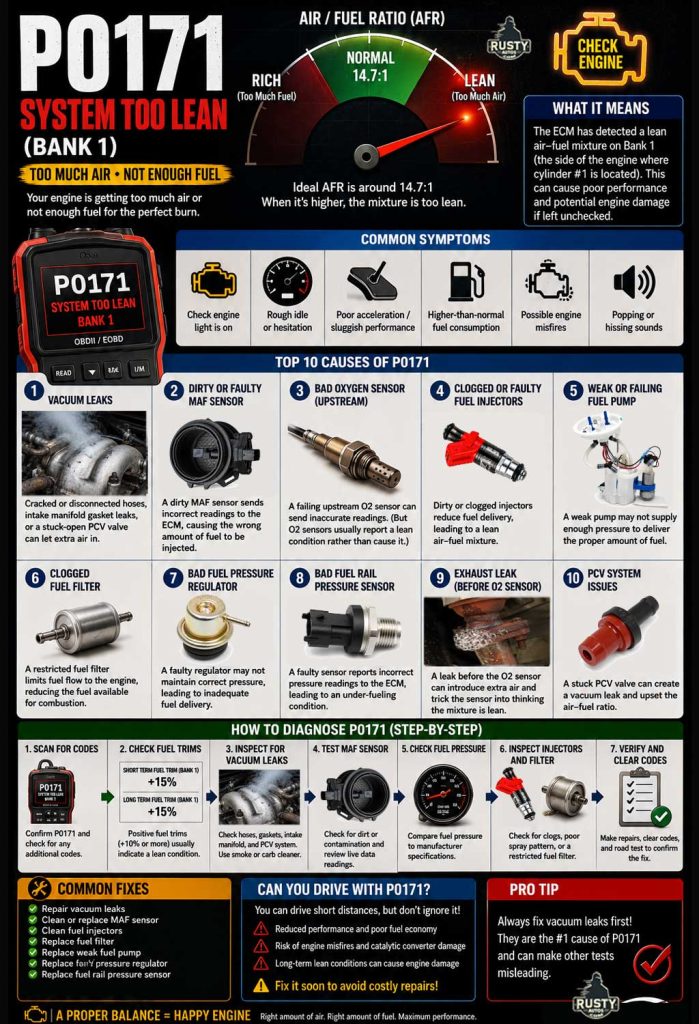
How to Diagnose and Fix a P0171 Code
What Is the P0171 Code
The P0171 trouble code means the engine control module has detected a lean air-fuel mixture on bank one. This means there is too much air or not enough fuel in the combustion process, which can lead to poor performance, hesitation, and potential long-term engine damage if left unchecked.
A properly running engine maintains a balanced air-fuel ratio of around 14.7 parts air to one part fuel. When the engine runs too lean, it means the mixture has too much air or too little fuel, causing the oxygen sensors to detect an imbalance and trigger the check engine light with the P0171 code.
Bank one refers to the side of the engine where cylinder one is located. This code is common on both naturally aspirated and turbocharged engines, but the causes can vary depending on the engine design.
In the next section, we will go over the most common symptoms of a P0171 code and what signs to look for if your engine is running lean.
Symptoms of a P0171 Code
A P0171 code often starts with subtle performance issues that can worsen over time. Because the engine is running too lean, it may struggle to maintain smooth operation, especially under load. Here are the most common symptoms to watch for.
Check engine light is illuminated. The first and most obvious sign is the check engine light. The P0171 code is stored when the engine control module detects a consistently lean condition on bank one.
Rough idling or engine hesitation. A lean mixture can cause the engine to run unevenly at idle. You may notice fluctuating RPMs, engine stumbling, or hesitation when accelerating.
Poor acceleration and sluggish performance. With too much air and not enough fuel, combustion efficiency drops, making the engine feel underpowered or unresponsive when pressing the accelerator.
Higher-than-normal fuel consumption. Although a lean condition means less fuel is being injected, it can force the engine to compensate by adjusting fuel trims, which can lead to excessive fuel use over time.
Possible engine misfires. Running too lean can lead to misfires in one or more cylinders, causing jerking or rough running. This may be more noticeable when the engine is cold or under heavy acceleration.
Unusual engine sounds. A lean condition can sometimes cause popping noises from the intake or exhaust, especially when the throttle is opened suddenly.
If your vehicle is showing one or more of these symptoms, diagnosing and fixing the issue quickly is important to prevent potential engine damage. In the next section, we will break down the most common causes of a P0171 code.
What Causes the P0171 Code
A P0171 code is triggered when the engine is running too lean, meaning there is too much air or not enough fuel in the combustion process. This imbalance can be caused by a variety of issues, ranging from simple vacuum leaks to fuel system failures. Below are the most common causes.
Vacuum leaks. Unmetered air entering the intake system can throw off the air-fuel ratio. Common sources include cracked or disconnected vacuum hoses, intake manifold gasket leaks, and a stuck-open PCV valve.
Dirty or faulty mass airflow sensor. The mass airflow sensor measures incoming air and helps determine the proper amount of fuel. A dirty or malfunctioning MAF sensor can provide incorrect readings, leading to a lean condition.
Bad oxygen sensor. A failing upstream oxygen sensor can occasionally send inaccurate readings to the engine control module and trigger a P0171 code. However, oxygen sensors often report a genuine lean condition rather than causing it. Always check for vacuum leaks and fuel delivery problems before replacing an oxygen sensor.
Clogged or faulty fuel injectors. Dirty or partially clogged fuel injectors can reduce the amount of fuel reaching the cylinders, leading to an imbalance in the air-fuel mixture.
Weak or failing fuel pump. A failing fuel pump may not supply enough pressure to deliver the proper amount of fuel, resulting in a lean condition.
Clogged fuel filter. A restricted fuel filter can limit fuel flow to the engine, reducing the amount of fuel available for combustion.
Bad fuel pressure regulator. A malfunctioning fuel pressure regulator may not maintain the correct fuel pressure, leading to inadequate fuel delivery and a lean mixture.
Bad fuel rail sensor. A faulty sensor may report incorrect pressure readings, leading to an under-fueling condition.
Exhaust leaks before the oxygen sensor. A leak in the exhaust manifold or piping before the oxygen sensor can introduce extra air, tricking the sensor into detecting a lean condition.
PCV system issues. A stuck-open PCV valve or a cracked PCV hose can allow excess air into the intake, altering the air-fuel ratio.
Turbocharger Boost Leaks. On turbocharged engines, a split intercooler hose, a leaking charge pipe, or a loose boost clamp can allow metered air to escape before it reaches the engine. This can create a lean condition and trigger a P0171 code.
Since the P0171 code can be triggered by several different issues, proper diagnosis is essential before replacing parts. In the next section, we will outline the best methods to diagnose the root cause of the problem.
H2: How Serious Is a P0171 Code?
A P0171 code is usually not an emergency, but it should not be ignored.
A lean-running engine generates higher combustion temperatures, which can eventually damage internal engine components. Left unchecked, a lean condition can lead to poor performance, engine misfires, catalytic converter damage, and in severe cases, burnt exhaust valves.
If the vehicle is still driving normally, you can usually continue driving short distances while diagnosing the issue. However, if the engine is misfiring, lacks power, stalls, or displays multiple fault codes, repairs should be carried out as soon as possible.
Simple stuff first. Most P0171 codes are caused by vacuum leaks, dirty MAF sensors, or PCV system problems rather than major engine failures.
H2: Most Common P0171 Causes (Start Here)
In my experience, these are the most common causes of a P0171 code, listed from most likely to least likely.
- Vacuum leak
- Dirty mass airflow (MAF) sensor
- PCV valve or PCV hose leak
- Intake manifold gasket leak
- Weak fuel pump
- Clogged fuel injector
- Exhaust leak ahead of the oxygen sensor
- Faulty oxygen sensor
Starting with the most common causes can save a lot of time and money. On roadside calls, I always check for vacuum leaks and MAF sensor issues before reaching for expensive parts.
How to Diagnose and Fix a P0171 Code
Since a P0171 code means the engine is running too lean, diagnosing the problem involves checking for air leaks, fuel delivery issues, and sensor malfunctions. Below is a step-by-step process to find and fix the issue.
Step 1: Check for Additional Codes
- Use an OBD2 scanner to see if there are any related trouble codes, such as misfire codes (P0300-P0306) or other fuel system codes which may help diagnosis.
Step 2: Check Fuel Trim Data
If your scan tool displays live data, check the short-term fuel trim (STFT) and long-term fuel trim (LTFT) values.
Normal fuel trims are generally within plus or minus 10 percent.
If fuel trims are heavily positive, the engine control module is adding fuel to compensate for a lean condition.
A useful rule of thumb:
- High fuel trims at idle often indicate a vacuum leak.
- High fuel trims at all engine speeds often point toward a fuel delivery issue such as low fuel pressure or restricted injectors.
Fuel trim readings can often point you toward the root cause before any parts are removed.
Step 3: Test Oxygen Sensors
- Use an OBD2 scanner to monitor real-time oxygen sensor data.
- If the upstream O2 sensor readings are stuck lean, it may be faulty and require replacement.
Step 4: Inspect for Vacuum Leaks
- Listen for a hissing sound near vacuum lines, the intake manifold, or the PCV valve.
- Spray brake cleaner or carburetor cleaner around suspected leak areas while the engine is idling. If the idle fluctuates, there may be a leak.
Common areas for vacuum leaks include:
- Brake booster diaphragm leak
- Brake booster vacuum pipe leak
- Cracked intake manifold
- Intake gasket leak
- Leaking intake hoses
- Bad throttle body gasket
- PCV system leak
Step 5: Check for Exhaust Leaks
- Inspect the exhaust manifold and pipes before the oxygen sensor for leaks that could allow unmetered air into the system.
- If an exhaust leak is found, repair or replace the damaged section.
Step 6: Clean or Replace the Mass Airflow Sensor
- A dirty or faulty MAF sensor can cause incorrect air readings.
- Remove the sensor and clean it with MAF sensor cleaner, ensuring it is fully dry before reinstalling.
- If the problem persists, replacing the MAF sensor may be necessary.
Step 7: Test Fuel Pressure
- Connect a fuel pressure gauge to the fuel rail and compare the reading to the manufacturer’s specifications.
- If pressure is too low, the fuel pump, fuel filter, or fuel pressure regulator could be failing.
Step 8: Inspect and Clean Fuel Injectors
- Use a fuel injector cleaning solution to remove buildup.
- If misfires or lean conditions persist, consider replacing clogged or failing injectors.
How to Fix a P0171 Code
- Repair vacuum leaks by replacing cracked hoses or a faulty PCV valve.
- Replace a faulty oxygen sensor if it is sending incorrect data to the engine control module.
- Clean or replace the MAF sensor if it is dirty or malfunctioning.
- Fix exhaust leaks before the oxygen sensor to prevent false lean readings.
- Replace a failing fuel pump, fuel filter, or pressure regulator if fuel delivery is weak.
- Clean or replace clogged fuel injectors to ensure proper fuel flow.
Once repairs are made, clear the P0171 code with an OBD2 scanner and test drive the vehicle to ensure the check engine light does not return.
FAQs About the P0171 Code
Is it safe to clear the code and keep driving?
Clearing the code without fixing the issue may temporarily turn off the check engine light, but the problem will return if the underlying cause is not resolved. Driving with a P0171 code for too long can cause performance issues, overheating, and potential engine damage, so it is best to diagnose and fix it as soon as possible.
Can a bad gas cap cause a P0171 code?
No, a bad gas cap is not a common cause of P0171. Unlike EVAP system codes like P0455 (large EVAP leak), a loose or faulty gas cap does not directly affect the air-fuel mixture.
Can running premium fuel fix a P0171 code?
No, switching to premium fuel will not resolve a P0171 code. The issue is caused by an imbalance in the air-fuel ratio, not the octane rating of the fuel.
Will P0171 go away on its own if I clean my MAF sensor?
If a dirty MAF sensor is the root cause, cleaning it can resolve the issue, but the check engine light may not go off immediately. The ECM needs time to relearn fuel trims, or you can clear the code with an OBD2 scanner and monitor for reoccurrence.
How much does it cost to fix a P0171 code?
The cost depends on the cause. DIY fixes like cleaning the MAF sensor or replacing a vacuum hose can cost under $20, while fuel system repairs like a new fuel pump or injectors may cost several hundred dollars if done professionally.
What Fuel Trim Numbers Cause a P0171 Code?
Most vehicles will store a P0171 code when fuel trim corrections become excessive, typically around +20 to +30 percent combined fuel trim. This means the engine control module is adding a significant amount of fuel to compensate for a lean condition that it can no longer correct on its own.
Can a Vacuum Leak Cause Only a P0171 Code?
Yes. In fact, vacuum leaks are one of the most common causes of a P0171 code. Small leaks in vacuum hoses, intake manifold gaskets, brake booster hoses, or the PCV system can allow unmetered air into the engine and create a lean condition without triggering any other fault codes.
I know fixing a P0171 might feel like chasing a ghost, but most causes are simple to diagnose and repair. With a little patience (and maybe a can of MAF cleaner), you’ll have your engine running smoothly again in jig-time.
You may find the following pages helpful:
Would You Know What To Do?
If your engine warning light came on tonight, would you know to keep driving, pull over, or call for recovery?
Most drivers wouldn’t.
That’s exactly why I wrote this guide.

- About the Author
- Latest Posts


John Cunningham is an Automotive Technician and writer on Rustyautos.com. He’s been a mechanic for over twenty-five years and has worked for GM, Volvo, Volkswagen, Land Rover, and Jaguar dealerships.
John uses his know-how and experience to write articles that help fellow gearheads with all aspects of vehicle ownership, including maintenance, repair, and troubleshooting.