It’s just after midnight.
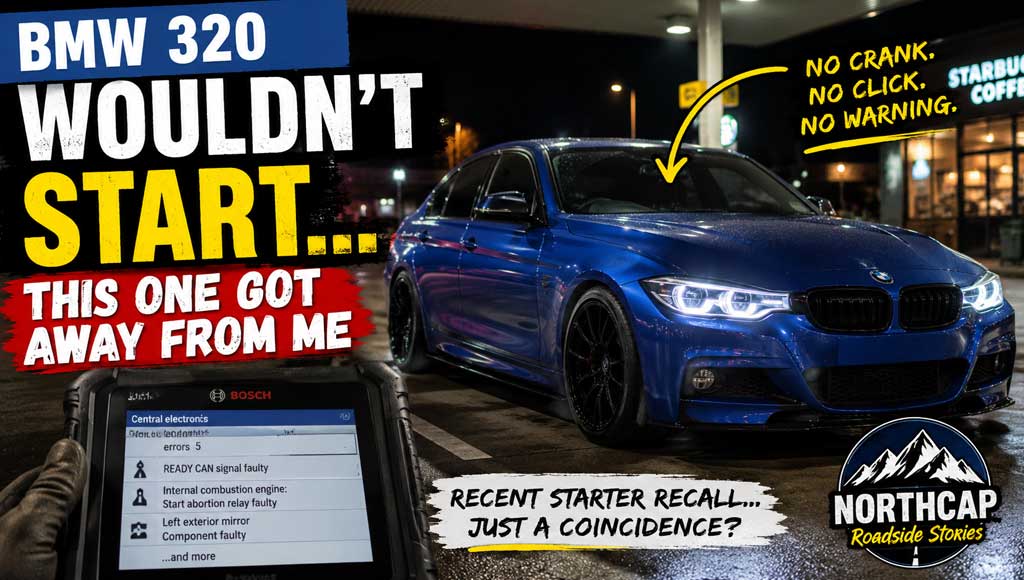
A metallic blue 2018 BMW 320d rolls into a gas station on the edge of the city. Black wheels. Tinted glass. Lowered suspension. The sort of car that tells you the owner takes pride in it.
The owner had stopped for a coffee on his way to work.
Five minutes later, he was stranded.
When the call came through, the notes looked straightforward enough:
“Battery flat. Won’t start.”
Perfect.
Battery jobs are usually quick. Test the battery, fit a replacement if needed, collect a signature, and move on to the next call.
Or so I thought.
When I arrived, the owner explained what had happened.
He’d parked up, grabbed a coffee, came back out, pressed the start button and…
Nothing.
No crank.
No click.
No warning message.
Just silence.
Now, here’s the thing.
A completely dead battery normally leaves clues.
Dim lights.
A slow crank.
Warning messages.
A dashboard that looks like a Christmas tree.
This BMW did none of those things.
The dash lit up perfectly.
The key was recognised.
The ignition switched on normally.
Every gauge came to life.
Everything looked exactly as it should.
Except the engine refused to crank.
That’s when I started to suspect this wasn’t going to be a simple battery replacement.
I connected the diagnostic tool and began working through the systems.
The engine control unit had several faults stored, but frustratingly, my Bosch scanner wouldn’t open them. Whether that was a scanner issue or something specific to the vehicle, I couldn’t tell at the roadside.
I was able to access the body electronics module; however, there were faults related to the vehicle’s start process.
At that point, I started checking the basics.
Brake pedal input?
Good.
Gear selector position?
Good.
Tried starting in Neutral?
Nothing.
Key detection?
Perfect.
Still not even a click from the starter motor.
Not a peep.
I even located the body control module and gave it the traditional roadside technician’s diagnostic tool…
A gentle tap.
Still nothing.
By now, it was becoming clear that this wasn’t the sort of fault that was going to reveal itself in a gas station parking lot at one o’clock in the morning.
Then I asked a question that changed the whole feel of the job.
“Has it done this before?”
The owner paused.
“Actually, yes.”
Twice.
Both times within the previous two weeks.
Each time, the car eventually started after several attempts.
Now we’re getting somewhere.
Intermittent faults are the hardest faults.
When the vehicle starts behaving itself, all the evidence disappears.
So I asked another question.
“Has any work been carried out recently?”
The answer caught my attention immediately.
The car had been back at BMW roughly three weeks earlier.
A starter motor had been replaced as part of a recall campaign.
Now, does that automatically mean the recent repair caused tonight’s breakdown?
No.
Not at all.
But when a vehicle develops an intermittent no-crank condition shortly after work on the starting system, it’s certainly worth mentioning.
At that stage, there wasn’t much more I could do roadside.
The car was a rear-wheel-drive automatic, so towing wasn’t an option.
This one needed a flatbed.
I suggested that the owner contact BMW first thing the following morning, explain the recent repair history, and describe the intermittent starting issue that had now progressed to a complete no-start.
He ordered a taxi.
I ordered a recovery truck.
Neither of us was particularly happy with the outcome.
Roadside technicians like fixing cars at the roadside.
Customers like driving away.
Unfortunately, every now and then, you meet a fault that refuses to cooperate.
This BMW was one of them.
The good news?
It failed in a gas station parking lot instead of on the highway.
Sometimes that’s the small victory you take.
The lesson here is simple.
If your vehicle occasionally refuses to crank but eventually starts after a few attempts, don’t ignore it.
Intermittent faults rarely fix themselves.
More often than not, they’re rehearsing for a complete failure at the most inconvenient moment possible.
This BMW gave plenty of warnings before the final no-start.
The trick is recognising them.
Would You Know What To Do?
If your engine warning light came on tonight, would you know to keep driving, pull over, or call for recovery?
Most drivers wouldn’t.
That’s exactly why I wrote this guide.

- About the Author
- Latest Posts


Meet Northcap, a seasoned mechanic and roadside assistance expert with over 20 years of hands-on experience. At Rustyautos.com, Northcap shares exclusive insights into what really breaks down in cars, offering practical tips and real-world advice to keep drivers informed and their cars on the road.