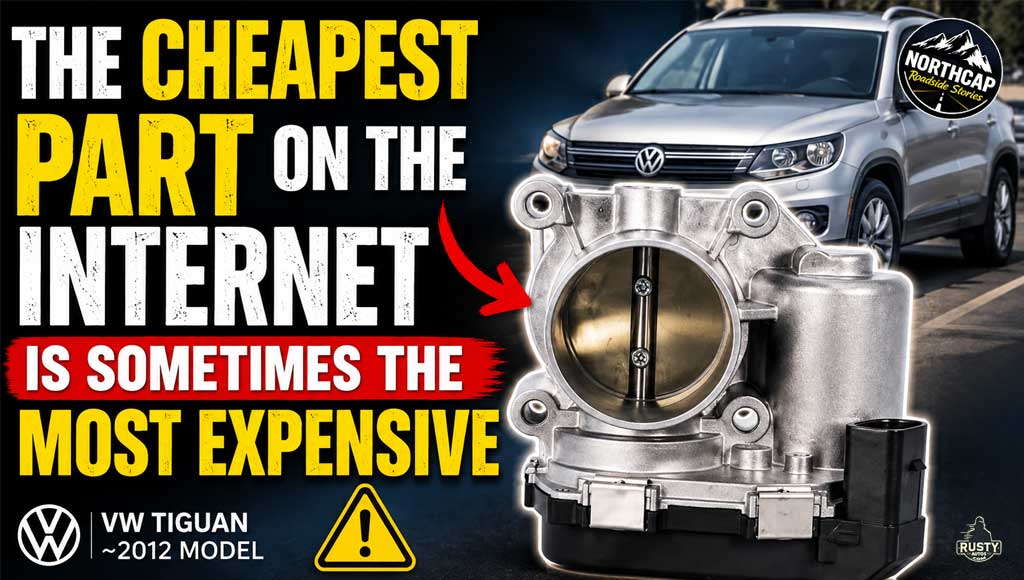
The call came in from a school parking lot.
A mom had just finished the morning school run in her Volkswagen family hauler.
Nothing unusual.
The engine started instantly.
It idled perfectly.
No smoke.
No rattles.
No warning signs other than one glowing check-engine light.
But there was one problem.
A pretty big one.
The vehicle wouldn’t accelerate.
At all.
You could push the gas pedal right through the floor and absolutely nothing happened.
The engine just sat there happily idling away as if the accelerator pedal wasn’t connected to anything.
Modern vehicles have a talent for turning simple faults into strange symptoms.
This was one of those days.
“I Already Know What’s Wrong”
When I arrived, the husband was already there.
Before I’d even opened the hood, he walked over and confidently told me what had failed.
“The throttle body.”
Now normally, when somebody tells me they’ve already diagnosed the fault, I become a little skeptical.
Not because they’re always wrong.
Because they’re often right for the wrong reason.
But this guy was different.
He was one of those DIY owners I genuinely respect.
He owned a scan tool.
He wasn’t afraid to get his hands dirty.
And he actually worked on his own vehicles.
Those are my kind of people.
So I listened.
Then I Spotted Something Interesting
I popped the hood.
Immediately something caught my eye.
The throttle body looked brand new.
Not cleaned.
Not serviced.
Brand new.
I asked if the vehicle had any recent repairs.
“Yeah,” he said.
“I replaced the throttle body about six months ago.”
That got my attention.
“Volkswagen part?” I asked.
He shook his head.
“No. Bought it online.”
“From where?”
“I think it came from China.”
Now we were getting somewhere.
New Doesn’t Mean Good
This is where a lot of DIY repairs go sideways.
People assume a new part can’t possibly be faulty.
Unfortunately, that’s not how it works.
I’ve seen brand-new sensors fail straight out of the box.
I’ve seen alternators fail within days.
I’ve seen ignition coils cause misfires before the customer even made it home.
A part being new doesn’t prove anything.
A genuine part tells you a little more.
A mystery part from the darkest corners of the internet?
That’s where life gets interesting.
The Clues Started Adding Up
The engine started perfectly.
Idle was stable.
Using my scan tool, I could see the accelerator pedal potentiometer was working exactly as it should.
Every time the pedal was pressed, the pedal position reading changed smoothly.
So the pedal wasn’t the problem.
The next question was whether the ECU was receiving that information and passing it on.
It was.
I could see the ECU commanding the throttle body.
That was important because it allowed me to eliminate a lot of possibilities very quickly.
Before condemning a throttle body, I like to prove the wiring is doing its job.
At the roadside, you don’t necessarily need the exact voltage specifications.
What you’re looking for is change.
Using a multimeter, you can back-probe the connector and monitor the signal wire while someone presses the accelerator pedal.
If the signal voltage changes as the pedal is applied, that’s a strong indication the wiring between the ECU and throttle body is intact.
In this case, everything pointed in the right direction.
The pedal was talking to the ECU.
The ECU was talking to the throttle body.
The throttle body had power.
The throttle body had a good ground.
Yet nothing happened when the accelerator was pressed.
No movement.
No response.
Nothing.
It was like nobody was home at the throttle body end.
One More Check
Before I completely condemned the throttle body, I wanted to rule out one more possibility.
A jammed throttle plate.
I removed the air intake hose and took a look inside.
Sometimes carbon buildup can cause a throttle plate to stick.
Not often, but often enough that it’s worth checking.
This one was spotless.
The throttle plate was clean.
It wasn’t jammed.
In fact, I could move it by hand.
Now, before the keyboard warriors jump into the comments, no, that’s not something I’d generally recommend doing on modern electronic throttle bodies.
But in this case, we were already dealing with a suspected failed unit, and I simply wanted to verify that the plate wasn’t mechanically seized.
It wasn’t.
Mechanically, everything looked fine.
Electronically?
Different story.
The Missing Clue
To make matters slightly more complicated, the original fault code was gone.
The owner had already cleared it before I arrived.
Unfortunately, he hadn’t written it down first.
That’s a mistake I see all the time.
Think of fault codes like footprints at a crime scene.
Once you wipe them away, the detective’s job gets a lot harder.
The Most Likely Culprit
Could it be a wiring fault?
Not likely.
Could it be an ECU issue?
No, I could see the ECU responding correctly to pedal input and commanding the throttle body.
When you’re standing beside a vehicle with a six-month-old aftermarket throttle body, good power, good ground, good signal inputs, and a throttle plate that refuses to respond…
You start with the obvious suspect.
The throttle body itself.
The evidence was lining up.
The replacement part was looking increasingly guilty.
I explained my thinking.
To his credit, he wasn’t defensive.
In fact, he laughed.
“Yeah,” he said.
“I cheaped out.”
We’ve all done it.
Sometimes you get away with it.
And sometimes you’re standing in a school parking lot six months later waiting for a tow truck.
YOUR CAR JUST SAID “UH-OH.”
Warning light? Won’t start? Weird noise?
Something smells expensive?
DON’T PANIC. KNOW WHAT TO DO NEXT.
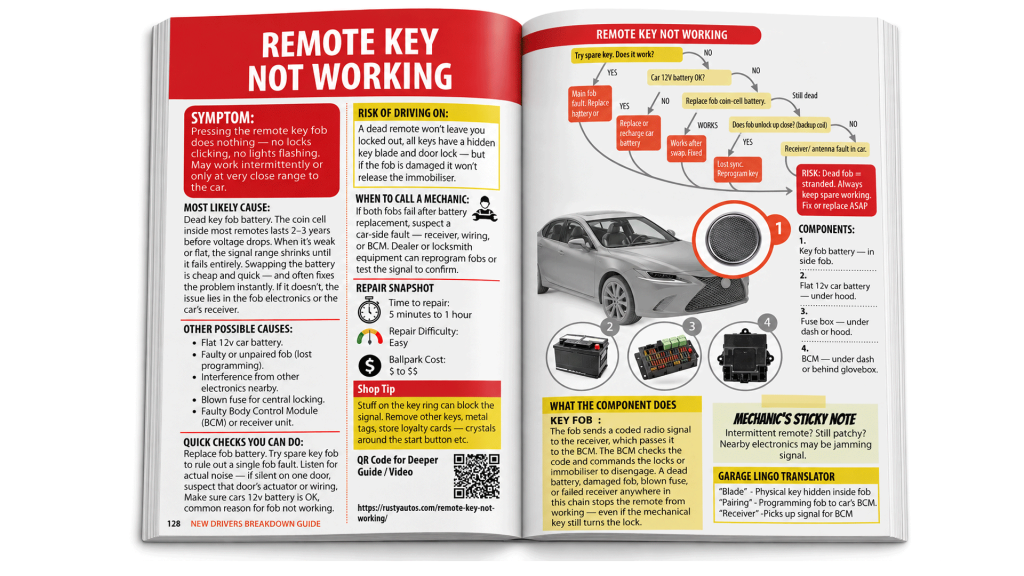
The New Driver’s Breakdown Guide gives you the car know-how nobody taught you.
- About the Author
- Latest Posts


Meet Northcap, a seasoned mechanic and roadside assistance expert with over 20 years of hands-on experience. At Rustyautos.com, Northcap shares exclusive insights into what really breaks down in cars, offering practical tips and real-world advice to keep drivers informed and their cars on the road.