Hit a bump.
Car keeps bobbing up and down like a boat.
That is not normal.
A healthy suspension should take the hit, settle the body, and get on with life. One bounce, maybe a small follow-up, and done.
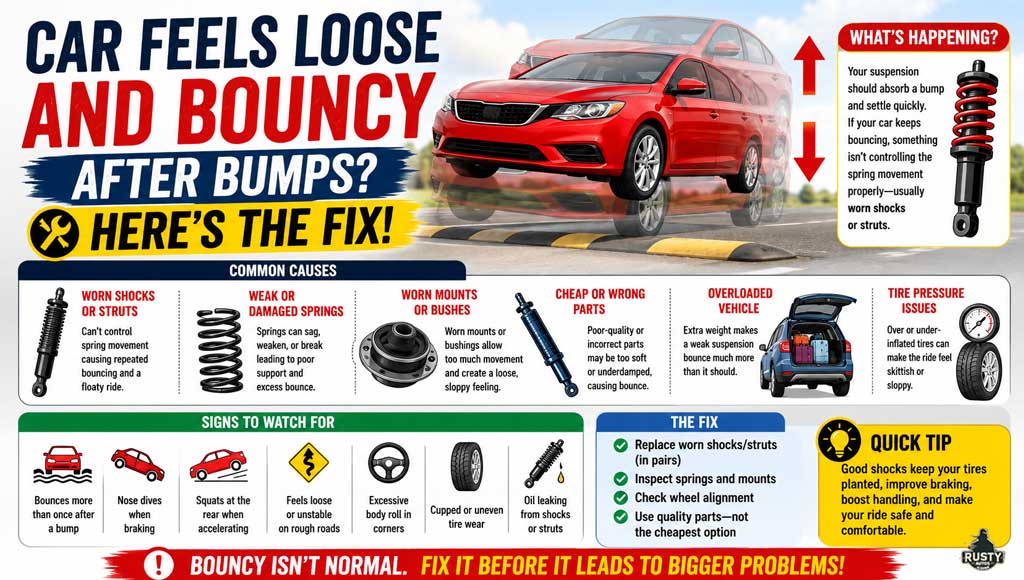
If your car keeps bouncing after bumps, dips, speed humps, or rough roads, the suspension is not controlling the spring movement properly. In plain English, something that should be damping the bounce is no longer doing its job.
Most of the time, worn shocks or struts are the culprit.
What the suspension is supposed to do
Your springs carry the weight of the car and absorb the hit.
Your shocks or struts control that spring movement.
Without dampers, the springs would keep bouncing long after the bump is gone. That is exactly why a car with weak shocks feels floaty, wallowy, and unsettled.
The suspension system is there to:
- Keep the tires planted on the road
- Control body movement
- Improve braking stability
- Help steering feel predictable
- Keep the ride from turning into a trampoline act
So when the car keeps bouncing, the problem is not just comfort. It is control.
Worn shocks or struts
This is the big one.
When shocks or struts wear out, they lose the ability to control the spring. The car hits a bump, the spring compresses and rebounds, but the damper cannot calm it down.
That gives you:
- Repeated bouncing after bumps
- Nose diving under braking
- Squatting at the rear when accelerating
- Excessive body roll in corners
- A floaty or loose feeling at speed
In the trade, this is the first place we look. If the car feels like it needs a second or two to gather itself after every road imperfection, worn dampers are high on the suspect list.
On many modern cars, the decline is gradual. Drivers get used to it. Then when new shocks go on, the difference feels massive.
Weak or damaged springs
Springs do wear out too.
A tired spring can sag, weaken, or even crack. If that happens, the suspension height changes and the car may bounce, bottom out, or feel loose over uneven roads.
You may notice:
- One corner sitting lower than the others
- A clunk from a broken coil spring
- The car leaning more than usual
- Harsh crashes over potholes followed by extra bounce
A broken spring does not always mean the whole thing snaps in half dramatically. I have seen plenty with just the bottom coil broken off. Easy to miss unless you get in there and look properly.
Worn strut mounts or shock bushes
Sometimes the damper itself is not the only problem.
The top mounts, rubber bushes, and suspension mounting points also help keep everything controlled. When they wear out, the suspension can move too much, knock, or feel sloppy over bumps.
This can add to the bouncing feeling, especially if the shock is already getting tired.
Common signs include:
- Knocking over rough roads
- A loose front end feel
- Vibration through the body
- Suspension noise when the car rebounds after a bump
- Noise from suspension struts when you turn the steering wheel from lock to lock
These parts rarely get the glory, but they matter.
Worn Suspension Bushings
Rubber suspension bushes help control how the suspension arms move.
When they crack, split, or soften with age, the suspension can feel vague and uncontrolled over bumps.
Drivers often describe it as:
- Loose
- Wandering
- Floaty
- Unsettled
Even when the shocks themselves are still serviceable.
This is particularly common on older European vehicles where the front control arm bushes work hard for a living.
Cheap or poor-quality replacement suspension parts
A car gets fitted with bargain-basement shocks or struts because they were cheap and available. The ride ends up too soft, underdamped, or just plain wrong for the vehicle.
So if the problem started after suspension work, do not rule out poor-quality parts or incorrect parts being fitted.
It is especially common on heavier vehicles, SUVs, and vans where the wrong spec damper quickly gets found out.
Overloaded vehicle
Load the trunk with tools, gear, bags of cement, or a holiday’s worth of luggage, and the suspension has a lot more work to do. If the shocks were only half-decent to begin with, extra weight can make the car bounce far more than usual.
Look at the timing.
If the bouncing is worse:
- With passengers in the back
- With a full trunk
- While towing
- After loading the vehicle heavily
Then the suspension may already be weak, and the added load is just exposing it.
Uneven or incorrect tire pressure
Tires are not the main cause of repeated bouncing, but they can make the ride feel odd.
Overinflated tires can make the car feel skittish and overly lively on rough roads. Underinflated tires can make the vehicle feel sloppy and unsettled.
Check pressures before going too deep into suspension diagnosis. Simple stuff first.
How to tell if shocks are likely worn out
There are a few clues that point strongly toward bad shocks or struts.
Watch for:
- The car bounces more than once after a bump
- The front dips hard when braking
- The rear squats when pulling away
- The car feels unstable on rough roads
- It drifts or wallows in corners
- Tire wear looks patchy or cupped
- You see oil leaking from the shock body
That last one is a giveaway. If a shock absorber is wet with oil, it is usually done.
Try the bounce test, but do not rely on it alone
The old-school bounce test still has some value.
Push down hard on one corner of the car and let go. If it rises and settles quickly, that is generally good. If it keeps bouncing, the damper is weak.
But here is the catch.
Modern suspension can fool you. Some worn shocks will pass a basic driveway bounce test and still be poor on the road. So it is a useful clue, not a final answer.
A road test and visual inspection tell you far more.
Is it safe to keep driving?
Sometimes yes, but it is not something I would ignore.
A bouncing car takes longer to settle after bumps. That means the tires can lose firm contact with the road, especially when cornering or braking on uneven surfaces.
That affects:
- Grip
- Steering control
- Braking distance
- Driver confidence
- Emergency handling
So while the car may still move down the road, it is not working at its best. And if the suspension is badly worn, things can go downhill fast in wet conditions or during sudden manoeuvres.
What a mechanic will check
If I had this one in front of me, I would usually check:
- Shock absorbers or struts for leakage
- Ride height at each corner
- Broken or sagging springs
- Top mounts and bushes
- Suspension arm bushes and ball joints
- Tire condition and pressure
- Signs of uneven tire wear
- Any recent suspension repair history
On a test drive, the way the body reacts after a bump tells you a lot. So does how the car behaves when braking into a dip or crossing rough surfaces at speed.
Typical fix
In most cases, the fix is replacing worn shocks or struts, and sometimes springs or mounts at the same time.
A few trade tips here:
- Replace shocks in pairs on the same axle
- Inspect springs and mounts while you are in there
- Get the wheel alignment checked after strut work
- Do not fit the cheapest parts you can find unless you enjoy doing jobs twice
A fresh set of quality dampers can completely transform how a car feels. Not glamorous. But one of the best ride and safety repairs you can do.
Final word
If your car keeps bouncing after bumps, the suspension is telling you it has lost control.
Most commonly, that means worn shocks or struts.
It might not seem urgent because the car still drives. But the longer you leave it, the more the handling, braking, and tire wear tend to suffer.
Bouncy might sound harmless.
It is not.
Would You Know What To Do?
If your engine warning light came on tonight, would you know to keep driving, pull over, or call for recovery?
Most drivers wouldn’t.
That’s exactly why I wrote this guide.

- About the Author
- Latest Posts


Meet Northcap, a seasoned mechanic and roadside assistance expert with over 20 years of hands-on experience. At Rustyautos.com, Northcap shares exclusive insights into what really breaks down in cars, offering practical tips and real-world advice to keep drivers informed and their cars on the road.