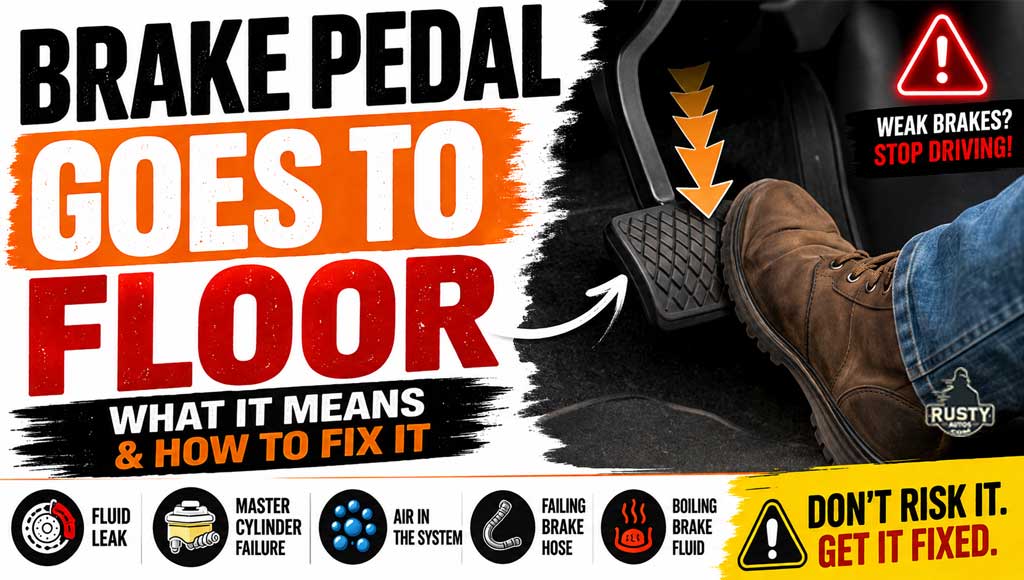
You press the brake…
And it just keeps going.
That sinking feeling in your foot?
Yeah, that’s not normal. And it’s not something you “keep an eye on.”
Stop driving it.
What’s Actually Happening
Your braking system relies on hydraulic pressure.
You press the pedal
Fluid moves
Pressure builds
Brakes apply
If the pedal goes to the floor, that pressure isn’t there.
Either it’s escaping, compressing, or not being created properly.
What You’ll Notice
- Pedal drops to the floor
- Very weak braking or none at all
- Pumping the pedal may bring it back briefly
- Increased stopping distance
- Brake warning light may be on
- Fluid level may be low
Sometimes it starts as a slightly soft pedal.
Then one day, it gives up.
Most Common Causes
Brake fluid leak
This is the number one cause.
If fluid is leaking, pressure is lost.
- Rusted or split brake lines
- Perished rubber hoses
- Leaking calipers
- Wheel cylinder leaks on drum brakes
Line lets go under braking, pedal drops instantly.
No warning.
Master cylinder failure
The master cylinder is the heart of the system.
If it fails internally, fluid bypasses the seals.
- Pedal slowly sinks when held
- No visible external leak
Hold steady pressure at a stop.
If the pedal keeps creeping down, suspect the master cylinder.
Air in the brake system
Air compresses.
Fluid doesn’t.
If air gets in, the pedal loses its solid feel.
- Spongy or soft pedal
- Improves when pumped
Usually caused by:
- Low fluid level
- Poor bleeding
- A leak that introduced air
Rear brake adjustment (drum brakes)
Still relevant on many cars.
If rear shoes are out of adjustment:
- Extra pedal travel
- Low pedal feel
- Often improves when pumped
Not usually a total failure, but it can feel close.
Bulging or failing flexi brake hose
This one catches people out.
The hose doesn’t leak.
It expands.
- You press the pedal
- Hose balloons under pressure
- Pressure is absorbed instead of applied
From the outside, it can look perfect.
But under load, it behaves like a weak spot.
Signs:
- Pedal drops under braking
- Feels better if pumped
- No fluid loss
I’ve seen hoses act like a sponge in the system.
Fix is simple.
Replace the hose and bleed the brakes.
If one has failed, check the rest.
Boiling brake fluid
Less common, but very real.
Especially with:
- Long downhill braking
- Heavy use
- Old brake fluid
Brake fluid absorbs moisture over time.
That lowers its boiling point.
When it overheats:
- Fluid boils
- Vapour forms
- Vapour compresses
Result
Pedal goes to the floor.
Here’s the twist.
Once it cools down, brakes can come back.
That throws people off.
Signs:
- Pedal fades after repeated braking
- Returns after cooling
- Heat or burning smell
Fix:
- Flush and replace brake fluid
- Check for overheating issues
Old fluid is a weak link.
ABS hydraulic unit issues
Less common, but possible.
- Internal fault in ABS module
- Pressure not maintained
Usually comes with warning lights and stored fault codes.
What I Check First at the Roadside
No guesswork here.
- Check brake fluid level
- Look for leaks around lines, callipers, and wheel cylinders
- Inspect hoses for bulging under pressure
- Press and hold pedal to see if it sinks
- Check for warning lights
If fluid is low
There’s a leak.
Brake systems don’t consume fluid.
Can You Drive It
No.
Even if pumping the pedal gives you some braking
You don’t know when it’ll fail completely.
Brakes are not a “chance it” system.
How to Fix It
Depends on the cause, but typical fixes include:
- Replace leaking lines or hoses
- Repair or replace calipers or wheel cylinders
- Replace master cylinder
- Replace weak or bulging flexi hoses
- Flush and bleed system
- Replace old brake fluid
Always bleed the system properly after repairs.
And double-check for leaks.
Pro Tip
If the pedal feel changes at all
Pay attention.
Your foot learns what “normal” feels like.
If it’s different, something’s off.
YOUR CAR JUST SAID “UH-OH.”
Warning light? Won’t start? Weird noise?
Something smells expensive?
DON’T PANIC. KNOW WHAT TO DO NEXT.
The New Driver’s Breakdown Guide gives you the car know-how nobody taught you.
- About the Author
- Latest Posts


Meet Northcap, a seasoned mechanic and roadside assistance expert with over 20 years of hands-on experience. At Rustyautos.com, Northcap shares exclusive insights into what really breaks down in cars, offering practical tips and real-world advice to keep drivers informed and their cars on the road.